

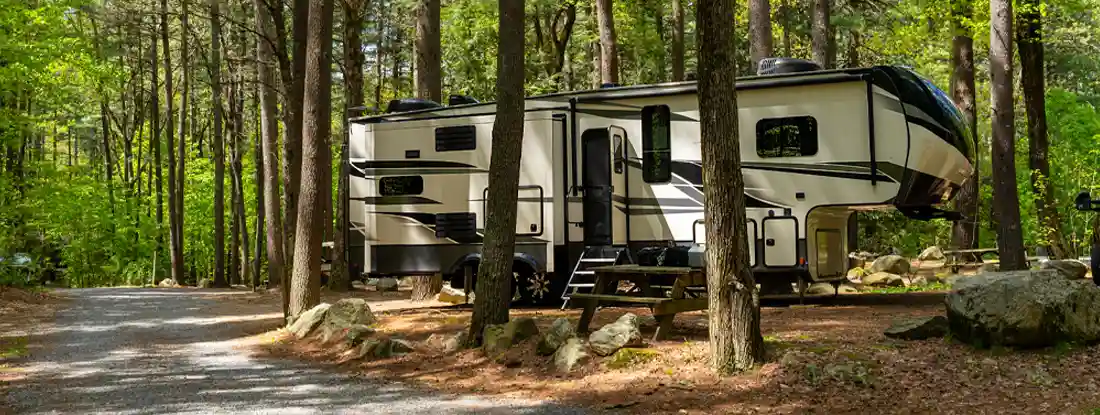

Full-time RV insurance covers people who live in their RV as a primary residence, typically six or more months per year. A standard recreational vehicle (RV) insurance policy focuses on on-road risks and leaves full-timers underprotected when their rig is parked at home. That's why having full-time RV insurance is essential.
Fortunately, a local independent insurance agent can help you find the right RV insurance for full-timers. They'll get you matched to the ideal coverage at a great rate. But first, here's a breakdown of full-time RV insurance, including what it covers and how much it costs in 2026.
Key Takeaways - Full-Time RV Insurance
Full-time RV insurance is usually required for people who live in their RVs for at least six months each year.
Full-time RV insurance is essentially a type of homeowners insurance designed for life on wheels.
The average cost of full-time RV insurance ranges from $500 to $1,500 per year, but costs can vary depending on the type of RV you have, its value, and other factors.
Working with a local independent insurance agent is strongly recommended, as they can shop and compare full-timer RV insurance quotes and policy options from multiple carriers near you to find the best price and fit.
What Is Full-Time RV Insurance?
Full-time RV insurance adds homeowner-style protections on top of a standard RV insurance policy. Also known as full-timer RV insurance or RV full-timers coverage, this type of policy protects against losses due to risks that arise when the RV is used as a permanent home. To qualify for full-time RV insurance, you typically must live in your vehicle at least six months per year. However, some carriers set the threshold at 150 days.
So, what is full-time RV insurance? Think of it as homeowners insurance designed for life on wheels. An independent insurance agent can help you get set up with the right RV insurance for a permanent residence.
Who Needs Full-Time RV Insurance?
Full-time RV insurance is necessary for people who have sold their home and live in their RV year-round, retirees traveling across the country as a primary lifestyle, and anyone using their motorhome or travel trailer as their permanent address. If you've been asking, "Do I need full-time RV insurance?" consider that if your homeowners insurance policy is no longer active, your personal belongings inside your RV may not be covered under a standard RV insurance policy.
The RV Industry Association’s 2025 Owner Demographic Profile reports that an estimated 486,000 Americans now live in their RVs full-time. If you're one of them, speak with a local independent insurance agent about full-time RV insurance. They can help you get set up with all the full-time RV lifestyle coverage you need to protect your personal belongings and more.
Full-Time vs. Standard RV Coverage: Key Differences
The core difference in an RV insurance comparison for a full-timer is the type of coverage required when the RV is parked as a home, not just a vehicle. The table below breaks down the differences between full-time RV insurance vs. standard RV insurance.
| Standard RV Coverage | Full-Timer RV Coverage |
|---|---|
| Covers on-road risks, including driving liability, collision, comprehensive, personal effects, and vacation liability when parked occasionally | Adds residential protections, including personal liability year-round, medical payments coverage, loss assessment coverage, higher emergency expense limits, and adjacent structures coverage |
What Full-Time RV Insurance Covers
Full-time RV insurance coverage includes all standard RV insurance coverage plus additional residential-use protections. So, what does full-time RV insurance cover specifically? The RV coverage types unique to or enhanced for full-timers are outlined below.
Full-timer's personal liability
This covers legal costs and medical bills if someone is injured in or around the RV while it's parked as a residence, rather than just a vehicle. Full-time RV liability coverage functions similarly to home insurance liability coverage.
Standard recreational RV policies only provide vacation liability, which covers occasional parking for short-term durations. In contrast, full-timer's liability RV insurance provides broader year-round protection. Work with an independent insurance agent to get set up with the right type of RV personal liability coverage for your situation.
Medical payments to others
RV insurance medical payments coverage provides no-fault protection that pays for medical bills for guests who are injured inside or near the parked RV. Coverage applies regardless of fault. Full-time RV guest injury coverage is important for full-timers who regularly host visitors at their campsites. Paying quickly for minor incidents and resulting injuries can prevent small claims from becoming expensive lawsuits.
Loss assessment coverage
RV loss assessment coverage pays for fees charged by an RV park HOA or association for shared property damage. Coverage varies by carrier and policy, but for example, Progressive covers up to $5,000 per incident.
Full-time RV HOA coverage can pay for many types of disasters. For example, a windstorm damages a shared picnic area, and the association bills all residents for repairs. Your RV park association insurance could help cover these costs. Unfortunately, many full-timers overlook this coverage entirely until they receive an unexpected bill.
Personal effects and belongings coverage
RV personal effects coverage is important for full-timers, since the RV carries all their personal property. Full-time RV belongings insurance extends your personal effects coverage to cover the full scope of belongings kept inside the RV.
However, RV contents coverage for full-timers comes with sublimits that apply to high-value items. This makes having a home inventory essential to ensure your coverage limits are adequate.
Emergency expense coverage
RV emergency expense coverage pays for hotel stays, takeout meals, and transportation if the RV becomes temporarily uninhabitable after a covered loss, such as a fire. Full-time RV temporary living expenses coverage operates similarly to a home insurance policy's loss of use coverage.
While coverage limits vary by carrier, Progressive provides up to $7,500 for full-timers and $750 for recreational users. When your RV is your primary residence, being stranded without it constitutes a housing emergency. As a full-timer, be sure to work with an independent insurance agent to get set up with all the emergency expense coverage you need.
Adjacent structures coverage
RV adjacent structures coverage covers any structures that are adjacent to the parked RV, such as awnings, decks, privacy fences, and outdoor storage, that full-timers often add at their campsite. Full-timer RV park setup coverage is directly analogous to Coverage B in a home insurance policy, known as additional structures coverage.
RV awning insurance is not offered by all carriers. Work with a local independent insurance agent to find a full-timer RV insurance policy that includes adjacent structures coverage.
How Much Does Full-Time RV Insurance Cost?
Full-time RV insurance costs an average of $500 to $1,500 per year. However, full-time RV insurance rates can vary depending on several factors, including the following:
- RV type and value
- Full-time use (i.e., year-round exposure)
- Coverage limits and deductibles
- Location
- Driving record
- Bundling discounts
So, how much does full-time RV insurance cost for your specific RV? Class A motorhomes cost significantly more to insure than travel trailers. A local independent insurance agent can help you compare full-timer RV insurance prices from carriers in your area.
Which Companies Offer Full-Time RV Insurance?
Several carriers offer RV insurance for permanent residences. Some of the best full-time RV insurance companies of 2026 are:
| Carrier | Best For |
|---|---|
| Progressive | Best overall |
| Nationwide | Best for discounts |
| National General | Best for customizable coverage |
| Good Sam Insurance Agency | Best for shopping around |
| Roamly | Best for full-time RVers |
Some carriers have strict eligibility rules for an RV's age and condition. If you're still wondering, "Who offers full-time RV insurance near me?" a local independent insurance agent can identify which carriers write full-timer policies for your specific RV and help you compare RV coverage.
How to Save on Full-Time RV Insurance
There are several ways to bring your premiums down easily if you've been wondering how to save on RV insurance for full-timers. To get cheap full-time RV insurance, try any of the following:
- Bundle your coverage with auto insurance or boat insurance
- Maintain a clean driving record
- Take an RV safety course (average discount of 5%-20%)
- Install anti-theft devices
- Choose a higher deductible
- Store your RV securely when not traveling
- Join an RV club like Good Sam
- Shop multiple carriers through an independent insurance agent
Independent insurance agents can help you find the best full-time RV insurance discounts and the cheapest rates from top-rated carriers in your area.
FAQs About Full-Time RV Insurance
What qualifies as full-time RV use for insurance purposes?
Most insurers define full-time use with the RV insurance 6 months rule, which refers to someone living in the RV for six or more months per year. However, some carriers use 150 days when determining what qualifies as full-time RV use. The RV must function as the primary residence. Full-time RV insurance definitions vary by carrier, so be sure to confirm the threshold with your insurer or independent insurance agent.
Is full-time RV insurance required by law?
No. Full-timers coverage is optional. However, liability coverage for self-propelled motorhomes is required in nearly every state. Full-time RV insurance isn't mandatory by law, but is a financial protection choice. So, if you've been asking, "Is full-time RV insurance required in my state?" the answer is no.
How does full-timer's liability differ from vacation liability?
Vacation liability covers injuries in or around the RV when parked at a campsite during a trip and is designed for occasional use. Full-timer's liability covers those same incidents year-round. You cannot carry both RV liability coverage types on the same policy, and full-timer's liability supersedes vacation liability. An independent insurance agent can further explain vacation liability vs. full-timer liability RV insurance.
Can I get full-time RV insurance for a travel trailer or fifth wheel?
Yes. Full-timers coverage is available for travel trailers, fifth wheels, and other towable RVs. If you live in a fifth wheel or travel trailer as your primary residence, full-timer coverages (personal liability, loss assessment, personal effects) can be added to a travel trailer policy. Note that liability for travel trailers while being towed comes from the towing vehicle. Ask a local independent insurance agent to help you find full-time RV insurance for travel trailers or fifth wheel full-time RV insurance.
Does full-time RV insurance cover personal belongings inside the RV?
Yes, personal effects coverage is included in most full-timers policies and covers belongings inside the RV against theft and covered perils. So, does RV insurance cover personal belongings that are expensive? Yes, but to an extent. Standard sublimits apply for high-value items under full-time RV personal property coverage, so a scheduled personal property endorsement may be needed for jewelry, art, and electronics above the sublimit.
What happens to my homeowners insurance when I live in my RV full-time?
If the home is sold and the RV becomes the primary residence, the homeowners policy lapses. Personal property coverage from the old homeowners policy does not follow into the RV under a recreational policy. As such, homeowners insurance doesn't cover full-time RV living.
A full-timers RV insurance policy fills that gap. An independent insurance agent can help coordinate the transition and help you better understand what happens to home insurance if you live in your RV.
How much does full-time RV insurance cost per year?
Average full-time RV insurance rates range from $500 to $1,500 per year, varying widely by RV class, value, coverage selections, and location. A Class A motorhome with full-timers coverage costs significantly more than coverage for a travel trailer.
Bundling with auto insurance can reduce costs. If you're still asking, "How much does full-time RV insurance cost?", an independent insurance agent can compare quotes from multiple carriers.
An Independent Insurance Agent Can Help You Find Full-Time RV Insurance
When you're ready to get set up with the right full-timer RV insurance, no one's better equipped to help than a local independent insurance agent. These agents have access to multiple carriers who specialize in full-time RV coverage, so they're free to shop and compare quotes and policy options to find the best blend of coverage and cost. And down the road, your agent can help you file RV insurance claims or update your policy when necessary.
Sources
https://www.roamly.com/learning-center/full-time-rv-insurance
https://www.progressive.com/rv-insurance/coverages/
https://insurify.com/specialty-vehicles/rv/best/