Boat Insurance Guide 2026: Quotes, Protection, & How It Works
 Written by
How will this quote help me?
Your quote is based on several common factors to give you a clear picture of the cost you can expect for boat insurance, though an independent agent can shop around and maybe even improve your rate!
NOTE: This quote is not final, though we did work with professional actuaries to help get you a ballpark figure to get started.

Boat owners can experience a lot of joy and excitement from their watercraft, but they also have to anticipate potentially costly disasters ahead of time. Aside from accidents on the water, a boat is also vulnerable to theft, vandalism, flood damage, and more. That's what makes having boat insurance so critical.
An independent insurance agent can help protect your vessel with the right boat insurance long before you ever need to file a claim. They'll match you with the right boat insurance policy for your unique vessel. But first, here's some boat insurance 101.
Key Takeaways - Boat Insurance Guide 2026
Boat insurance is only required by law in three states in 2026: Utah, Arkansas, and Hawaii.
If you finance your boat or dock it, you're also likely required to have boat insurance by your lender and/or marina.
Boat insurance costs range from $200-$657 annually, on average, in 2026.
Working with a local independent insurance agent is strongly recommended, as they can shop and compare boat insurance quotes and coverage options from multiple carriers near you to find the best deal.
What Is Boat Insurance?
Boat insurance is designed to cover boat owners and their vessels in case of various disasters, including accidents, fire, and more. These policies are intended to protect boats with motors, such as yachts and pontoon boats, but they don't cover kayaks or canoes. Boat insurance is important because homeowners insurance doesn't provide enough coverage on its own for most boats.
Which States Require Boat Insurance in 2026?
Only three states actually require boat insurance coverage in 2026: Hawaii, Arkansas, and Utah. The table below compares each state's boat insurance requirements.
| State | Coverage Minimums | Mandated For Which Boats |
|---|---|---|
| Arkansas | $50,000 liability coverage | Boats with engines over 50 HP |
| Utah | $25,000 bodily injury per person; $50,000 bodily injury per incident; $15,000 property damage | Boats with engines over 50 HP |
| Hawaii | $100,000 liability coverage | Vessels over 26 feet |
Additionally, there are a few situations where you may need boat insurance, even if you don't live in a state in which coverage is mandated. First, if you dock your boat at a marina, they may require some form of coverage in order to protect their business. Second, if you financed your boat, nearly every lender will require coverage to protect their investment.
Further, there are certain types of boats that are more important to insure than others due to their value, risk level, and more. Here's a handy guide to whether you need boat insurance for your vessel.
| Boats that need insurance: | Boats that don't need insurance: |
|---|---|
| Boats that have 25 horsepower or greater | Boats with less than 25 horsepower |
| Yachts | Small engine boats |
| Large sailboats | Small sailboats |
| WaveRunners | Canoes |
| Jet boats | Inexpensive boats |
Most often, boat insurance is purchased for:
- Yachts
- Sailboats
- Jet skis
- Utility boats
- Fishing boats
- Pontoon boats
Despite all the fun to be had with a boat, accidents and disasters can happen. The easiest way to protect yourself and others and get you back on the lake after a situation is with the right boat insurance.
However, if you own a Jet Ski, Sea-Doo, or another type of personal watercraft (PWC), you'll need a specific watercraft insurance policy. A local independent insurance agent can help you review boat insurance coverage options for the various types of boat insurance to get set up with the right coverage.
Best Boat Insurance Companies
While many carriers offer boat insurance, it's helpful to know some of the top names in the industry before you start shopping. Here are a few of our highest-recommended boat insurance companies.
| Best Boat Insurance Companies | Star Rating |
|---|---|
| Progressive |

|
| Travelers |
|
| Foremost |
|
| Nationwide |

|
| Liberty Mutual |

|
An independent insurance agent can help you get the right boat insurance policy for you from one of these top-rated carriers or another that best meets your needs.
When Do You Actually Need Boat Insurance?
If you lease or otherwise finance your boat, you're likely to be required by your lender to carry boat insurance, and often you'll need both collision and comprehensive coverage. When docking your boat, you're often also required by the marina to have liability coverage, even in states where a full boat insurance policy isn't mandatory by law.
Further, if you have a high-value vessel, you'll likely want to protect it with adequate coverage for its full replacement value. However, with boating accidents being so common, it's important to at least consider getting boat insurance for yourself.
Most Common Types of Boating Accidents
In 2024 alone, boating accidents caused $88 million in property damage (2024 is the latest year of data available from the Coast Guard). The biggest contributing factors to these accidents were boater inattention, inexperience, and excessive speed. Overall, the most common causes of boating accidents are:
- Operator inattention
- Improper lookout
- Operator inexperience
- Excessive speed
- Alcohol use
- Machinery failure
- Navigation rules violation
- Inclement weather
Notice that the top five causes of boating accidents are due to human error, such as inattention, improper lookout, alcohol use, and inexperience. Since you can't often blame the boat for an accident or other disaster, it's even more critical to ensure that your vessel is covered with the right insurance. If you do need to file a claim after an accident, see our guide on how to file a boat insurance claim.
How Much Is Boat Insurance?
The average annual cost of boat insurance ranges from $200 to $657, depending on the type of boat you have and other factors. It also depends on which types of coverage you need and how much coverage you need. For boaters who only purchase liability coverage, you might pay less than $100 annually.
Coastal and hurricane-prone states have consistently higher boat insurance rates due to the risk of weather damage, destruction, and related accidents. Often, however, you can expect the annual cost of boat insurance to be between 1% and 5% of the value of your boat. For example:
- $20,000 boats cost about $300 annually to insure
- $50,000 boats cost about $750 annually to insure
- $100,000 boats cost about $1,500 annually to insure
- $500,000 boats cost about $7,500 annually to insure
- $2 million boats, like yachts, cost about $30,000 annually to insure
- If you are looking for boat insurance for older boats, costs will vary significantly
The cost of your boat insurance might not be this simple to figure out, though. For more help calculating the cost of your premiums, use our boat insurance calculator or reach out to an independent insurance agent for a quote.
What Factors Influence Boat Insurance Costs?
Like any form of coverage, boat insurance costs depend on several factors, including:
The make, model, and value of your boat
Your boat's make, model, and value influence the cost of boat insurance because the more expensive your boat is to replace or repair, the more expensive your coverage must be. If your boat is valued at less than $20,000, you will pay approximately the average cost in your state. If your boat is valued above $500,000, you might pay up to 2,250% of the average cost in your state.
Your boat's length
Boat insurance costs also depend on the length of your boat. Be prepared to pay about 66% more for your coverage if your boat is 100 feet or longer, but if your boat is less than 20 feet, you may pay 12% less than average rates in your state.
Your boating records
If you've had six or more accidents or violations within the past five years, you can expect a 90% increase in your boat insurance premiums. However, if you've had no incidents during this time, you can expect a 40% decrease in your boat insurance premiums.
Your location
Boat insurance premiums vary considerably by the state you live in. Many factors can influence insurance costs by location, including crime rates, property values, and more.
How you use your boat
Depending on the risk level of the activities you perform with or on your boat, your premiums may be higher or lower. Using a boat for towing can be riskier than just using it for fishing, so boats used for fishing would be likely to have lower boat insurance premiums.
How often you use your boat
Similar to auto insurance, how often you use your boat can also influence your boat insurance rates, because the more you use it, the more likely an accident or other disaster is to occur. For boats that are only taken out on occasion, premiums for boat insurance can be much lower than those that are used daily on the water.
How you store your boat
If you store your boat in a garage rather than a marina, you can reduce your insurance premiums by approximately 20% with certain carriers.
An independent insurance agent can provide you with quotes for boat insurance from several carriers near you.
How to Save on Boat Insurance in 2026
Many insurance companies offer several discounts on boat insurance to help lower the cost of your premiums. Here are just a few common boat insurance discounts:
- Boater safety course discount: You might qualify for a discount on boat insurance if you complete a U.S. Coast Guard (USCG) Auxiliary or National Association of State Boating Law Administrators (NASBLA)-approved boater safety course. Savings average 10%-15% off with many carriers.
- Bundling discount: Many insurance companies offer discounts if you bundle your boat insurance with another policy through them, such as auto insurance or home insurance.
- Paid-in-full discount: Many insurance companies lower your overall premium if you pay for your entire year's worth of coverage up front.
- Homeowners discount: Some insurance companies even offer discounts on your boat insurance just for being a homeowner, even if your coverage is not through the same carrier.
- No claims history discount: If you've never filed a claim on your boat insurance, your carrier is likely to reward you with a discount over time.
- Diesel-powered boat discount: Some boat insurance companies offer discounts for watercraft with diesel-powered engines.
- Higher deductible savings: If you increase your deductible from $250 to $1,000, you might be able to reduce your premium rate by 15%-20%. However, you'll have to pay $750 more out of your own pocket if you file a claim.
- GPS tracker discount: Installing a GPS tracker in your boat can lead to a theft coverage premium deduction of about 15% with certain carriers.
- Garage/dry storage discount: If you store your vessel in a garage instead of at a marina, you may save an average of 20% with many carriers.
Your independent insurance agent is a great ally in helping you find any discounts you may qualify for on boat insurance, no matter which carrier you go through.
What Does Boat Insurance Cover?
Boat insurance provides a lot of important protection, not only for your boat, but also for you, your passengers, and everyone else on the water or at the marina. So, what is covered by boat insurance in 2026? Boat insurance typically includes the following primary coverages:
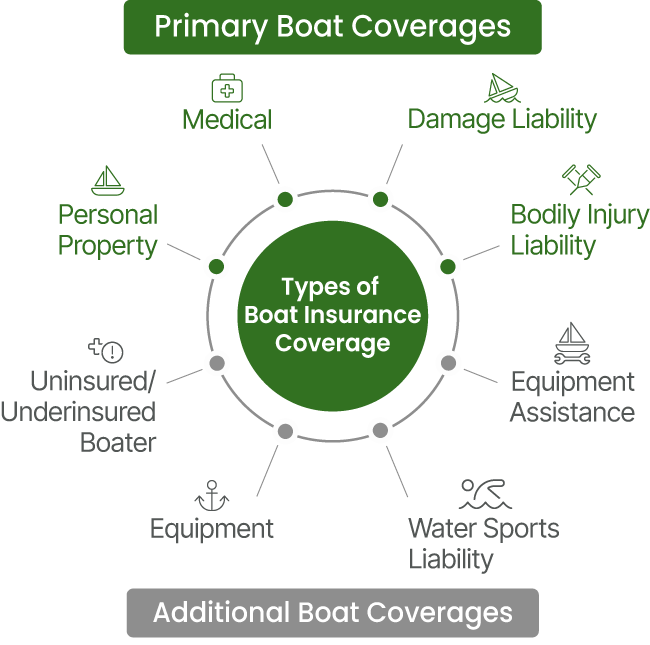
- Personal property damage: Provides reimbursement for your boat, trailer, and engine if they're damaged by a covered peril like vandalism, fire, etc.
- Medical payments: Provides reimbursement for treatment of injuries to you and your passengers who get hurt by your boat or while on your boat.
- Property damage liability: Provides reimbursement of property damage lawsuit costs from third parties due to your boat.
- Bodily injury liability: Provides reimbursement for injuries to anyone who gets physically harmed by your boat.
The following boat coverage types are commonly added to standard boat insurance:
- Uninsured/underinsured boaters: Covers injury expenses if the other boater is responsible but doesn’t have any, or enough, insurance to cover your expenses.
- Fishing equipment: Sometimes included, you'll be reimbursed up to a certain limit, like $1,000.
- Water sports liability: Some policies exclude water sports from your liability coverage, and some don't, but this coverage is important if you'll be doing stunts, etc.
- Emergency assistance on the water: Also known as boat towing insurance, coverage provides water towing and other assistance services through a maritime dispatch center.
- Roadside assistance for your boat and trailer: This coverage guarantees that the towing company will take your vehicle, boat, and trailer to the nearest facility if you get stranded on the road.
- Pollution liability: This coverage can pay for the cost of cleanup services after a fuel or oil spill you cause, and cover any liability expenses if you cause property damage or bodily injury to others from the incident.
If you have questions or concerns about your plans on the water, it's best to talk to your independent insurance agent. They can help you find and increase coverage so that it works best for you.
Agreed Value vs. Actual Cash Value: What's the Difference?
An agreed hull value (AHV) boat insurance policy pays for the full insured amount of your boat when you file a claim, without factoring in depreciation. An actual cash value (ACV) boat insurance policy factors in depreciation at the time of a loss, meaning your boat insurance payout may be significantly less for older vessels. AHV coverage is often recommended for new or high-value boats.
If you have a boat valued at $60,000 and have agreed value coverage in your boat insurance, your policy will pay out $60,000 if your vessel is ruled a total covered loss. However, an ACV policy might only pay out $42,000 if your vessel is totaled, since it factors in depreciation.
Agreed value policies cost an average of 10%-20% more than ACV policies, but are strongly recommended for boats valued at $30,000 or more. However, raising your policy's deductible from $500 to $1,000 can help reduce your premium by 10%-20%. Keep in mind, though, that you'll have to pay that much more out of your own pocket if you file a claim.
Important Additional Coverages for Boats
Beyond the standard coverages, it's always recommended to consider additional coverages to tailor the policy to your unique risks. Here are several optional boat insurance coverages worth considering:
- Collision: Provides coverage for collisions between your watercraft and other vessels or objects. You're also covered if your boat capsizes on the water.
- Comprehensive: Covers other disasters beyond collision, like theft, vandalism, storm damage, and more.
- Hurricane hauling services: Covers the cost of moving your watercraft out of the county where it's docked in case of an emergency.
- Personal property coverage: Personal property is usually covered under your homeowners policy, even when the boat isn't at your house. However, your deductible is often higher, so you can add personal property coverage on your boat policy to avoid a homeowners claim.
- Pollution liability: Pays for the cost of cleanup services after a fuel or oil spill you cause, and any liability expenses if you are sued for the incident.
- Wreckage and fuel removal: Reimburses the cost to recover or destroy wreckage and fuel if you get in an accident.
- Replacement cost or agreed value: Newer and more expensive boats can be insured for agreed value, which means you'll recover the full amount you paid for it, without depreciation.
- Pet coverage: If you boat with a pet on board, this provides up to $1,000 towards veterinarian fees if they're injured on the boat.
An independent insurance agent can recommend additional boat insurance coverages that are a good match for you.
What Is Boat Rental Insurance Coverage?
Boat rental insurance is often required by boat rental companies to protect against lawsuits that may arise when you operate a rented vessel. If a third party sues you for claims of bodily injury or property damage when you're operating a rented boat and you don't have boat rental insurance, you'll have to pay out of pocket for your defense and settlement costs.
What Boat Insurance Will Pay For
Before settling on a boat insurance policy, it's important to understand just what it will reimburse you for and what it won't. Keep in mind that specific coverage exclusions vary by policy and carrier. Here's a breakdown for further clarification.
| Boat insurance pays for: | Boat insurance won't pay for: |
|---|---|
| Physical damage due to covered causes like theft, fire, etc. | Maintenance costs. |
| Physical damage to the boat and anchors or other equipment. | Machinery damage or defective equipment and boat components. |
| Medical expenses for those injured on or by your boat. | Medical expenses relating to shark bite injuries. |
| Property damage to others caused by your boat. | Property damage caused by insect infestations, mold, barnacles, etc. |
| Liability issues that arise when someone else drives your boat with permission. | Intentional harm caused to others with your boat. |
If you still have questions about what's covered or not covered by boat insurance, your independent insurance agent can help.
Can You Pause Boat Insurance in the Off-Season?
Yes, with certain carriers. Some boat insurance companies allow you to purchase seasonal lay-up coverage in which your coverage reduces to comprehensive-only during non-boating months, such as winter. However, if your boat is financed, lenders typically require you to have year-round coverage. Ask your independent insurance agent about boat insurance lay-up periods and seasonal boat insurance to find out if you can pause your coverage for a discount.
FAQs About Boat Insurance
Do you have to have boat insurance on a boat?
Only three states require boat insurance by law (i.e., Hawaii, Utah, and Arkansas), but there are a few instances where you may need it. If you dock your boat at a marina, they may require some form of coverage in order to protect their business. Also, if you finance your boat, nearly every lender will require coverage to protect their investment; use our list of the best boat insurance companies as a starting point.
Other than that, you should always have at least liability coverage on your boat to protect yourself against lawsuit costs if you cause bodily injury or property damage to another party. Property coverage is optional, but again, the more comprehensive your coverage, the better it can protect you.
How much is boat insurance?
In 2026, the average cost of boat insurance ranges from $200-$657 per year for most recreational vessels. The cost of any boat insurance policy depends on a number of factors, including your boat's size, value, and horsepower. Typically, boat insurance costs average 1%-5% of your boat's value per year.
Do I need to insure my boat trailer?
Insuring your boat trailer is always a safe bet. Though your boat trailer may be protected by your home or car insurance policy, you can also add coverage to your boat insurance for your trailer. It's best to talk to your independent insurance agent about your boat, the trailer, and how you use it to determine the right coverage amount.
Does boat insurance cover passengers?
If your policy includes medical payments coverage, it will cover injuries to your passengers if you get into an accident. Medical payments coverage is an important option because just one accident can cause injuries that are extremely costly to treat.
Does boat insurance cover theft?
Typically, yes. But it's important to review your specific boat insurance policy with your independent insurance agent to make sure. Every carrier and every policy is different, but the more you know about your own policy, the better it will help protect you.
Does boat insurance cover hurricanes?
In most cases, yes, your boat will be covered against hurricane damage. But, as with any other natural disaster or unexpected event, you'll want to double-check your policy.
Does boat insurance cover me if I hit a rock?
If you have collision coverage on your boat insurance, you should be covered for the cost of repairs if you hit a rock.
Does boat insurance cover a blown engine?
In certain cases, boat insurance may cover a blown engine if the disaster was due to a listed peril. For example, ice and freeze damage to engines is typically covered. However, blown engines due to the owner's negligence are not covered.
Why Choose an Independent Insurance Agent?
Independent insurance agents simplify the process by shopping and comparing boat insurance quotes for you. Your agent can compare lay-up and seasonal boat insurance options across several carriers in your area. They'll find the right coverage at a great rate.
Independent insurance agents have access to multiple insurance companies, ultimately finding you the best boat insurance, accessibility, and competitive pricing while working for you.