


Your home is much more than a place to hang your hat. It's where you store your personal belongings and even host company on occasion. If a disaster occurred that resulted in property damage or injury, you might have to file a claim through your homeowners insurance. But there are some instances when filing a claim just isn't worth it.
Fortunately, an independent insurance agent can help you determine when it would be beneficial to file a home insurance claim. They can also file claims for you directly. But first, here's a breakdown of the home insurance claims process and when it makes sense to file one.
Key Takeaways - How to File a Home Insurance Claim
The homeowners insurance claims process involves multiple steps, starting with documenting damage and ending with completing repairs and receiving payment.
Not all damage is worth filing a home insurance claim for, such as small losses that wouldn't exceed your deductible.
Home insurance claim timelines depend on the type and severity of damage, with those for catastrophic events often taking longer to resolve.
Incomplete documentation and missed deadlines are common claim mistakes that can result in delayed or denied claims or reduced payouts.
Working with an independent insurance agent is highly recommended, as they can file claims through your insurance carrier directly for you and keep you updated throughout the process.
When Should You File a Homeowners Insurance Claim?
You may want to file a home insurance claim if your property suffers extensive damage for which the payout would greatly exceed your policy's deductible. You might also want to keep your claims history in mind before deciding to file through your home insurance company. If you've filed several claims already, you may not want to risk increasing your premiums again.
Overall, the decision of when to file a homeowners insurance claim doesn’t have to be a difficult one. Keeping these four major determining factors in mind can greatly help to simplify your decision if you’re ever on the fence.
File a home insurance claim if one of the following applies:
- The loss exceeds your predetermined amount: Some homeowners automatically file claims for any damage that will exceed their deductible, no matter how small the amount. It’s up to you to decide what amount will be your baseline for filing a claim. Consider how much money you’d be willing to pay out of pocket for various incidents and how much your deductible would have to be exceeded to justify going through the claims process for you.
- The incident could become a liability claim: Any incident that could turn into a liability claim should be reported to your insurance company immediately. Insurance contracts typically state that it’s the policyholder’s duty to report liability incidents, such as injuries, ASAP. It’s best to go ahead and file even if the claim seems minor, because the sooner you report an incident, the better chance your insurance company has of defending you.
- There’s property damage you can’t fully assess: It’s not always possible to assess the extent of property damage at first glance. Damage may be much more extensive (and costly) than you’re able to determine upfront. Until a professional inspection has been done, it’s impossible to know the full extent of the damage or the cost of repairs. It’s best to file this type of property damage as a claim so you can get the right amount of reimbursement for necessary repairs.
- The damage is too costly for you to fully cover yourself: In the event of a particularly expensive incident, it’s wise to file a claim to try to secure some financial reimbursement from your insurance company. It’s also helpful to file a claim for larger incidents because the insurance company will arrange for a professional evaluation of the extent of the damage.
While it’s not possible to list every potential scenario in which an insurance claim should be filed, these examples may serve as a good springboard for you to make your decision. In short, if the damage, theft, or incident was significant, you should file a claim right away. But if only a bike was stolen, you may not want to file a claim.
The value of your bike is probably insignificant compared to the risk of having your premiums increase. So, after any incident, try to weigh the possible risk of a premium increase against the out-of-pocket replacement cost to decide whether it’s worth the claim. Your independent insurance agent can also help you determine when it is appropriate to file a claim.
When Shouldn't You File a Home Insurance Claim?
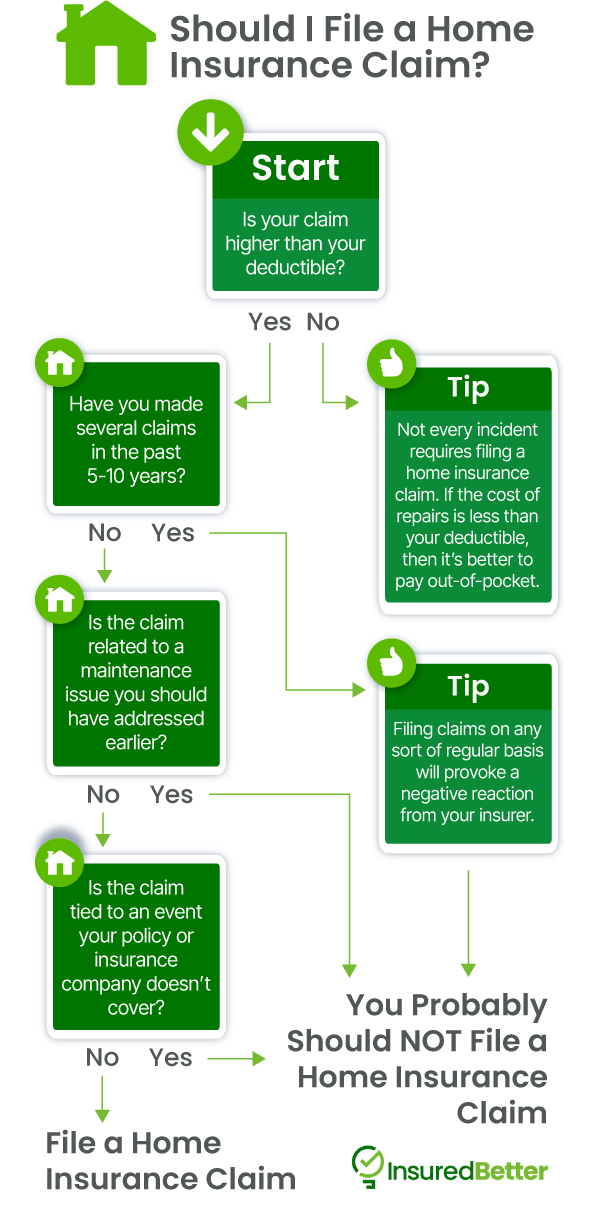
Certain scenarios can make filing a home insurance claim not worth it, such as minor damage that wouldn't exceed your deductible. Filing home insurance claims comes with the risk of not only denial by your carrier but also of them increasing your policy's premiums or even canceling it entirely. But if there is significant damage to your home, and the cost to repair or replace it will drastically outweigh your deductible, you'll likely want to file a claim anyway.
Here are a few examples of when you should not file a home insurance claim:
- If your claim is not much more than your deductible: In this case, the payout won’t be worth the potential increase in premium.
- If you’ve made several claims in the past 5 to 10 years: This could cause your insurance company to drop your coverage entirely.
- If the claim is for something your insurance doesn’t cover: If you try to file a claim for something your home insurance policy excludes, it will be denied automatically.
- If the damage is related to poor maintenance: Insurance companies consider routine home maintenance to be the homeowner's responsibility, so coverage is not provided by your policy.
Your independent insurance agent can help you decide if filing a home insurance claim is worth it based on your specific scenario.
Step-by-Step Process for Filing Homeowners Insurance Claims
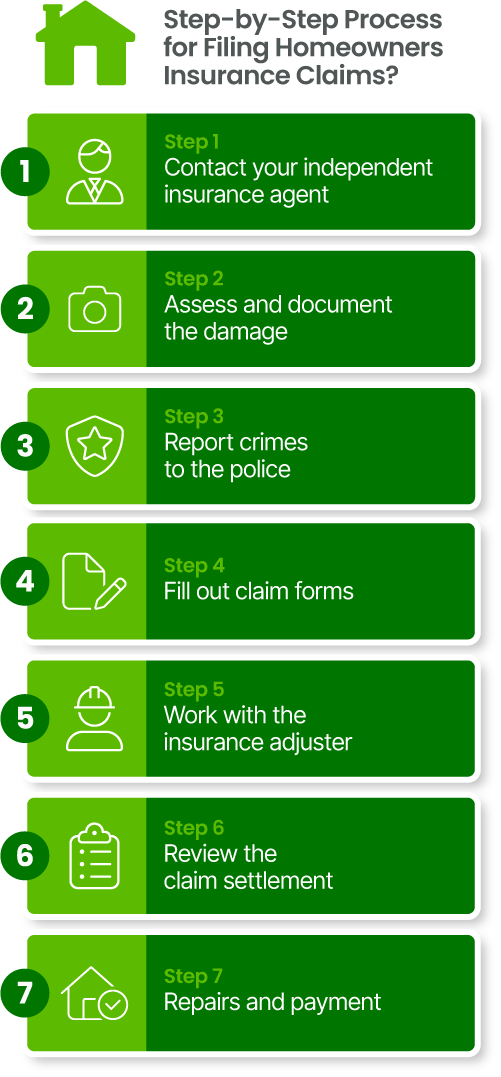
Whether your home was vandalized, damaged by a storm, or something else, you might need to file a home insurance claim. Here's what to do if a disaster happens to your home. Follow these simple steps to file a home insurance claim.
Step 1. Contact your independent insurance agent
When you decide to file a homeowners insurance claim, you’ll start by contacting your agent. They can help guide you through the process, outline the actions your insurance company will take next, and answer any questions you may have.
Step 2. Assess and document the damage
Take photos and videos of the damage and make a list of what’s been destroyed or stolen. If the damage is structural, use caution when shuffling through your home.
Step 3. Report crimes to the police
If you’ve been burglarized, contact the authorities right away. You'll need to let the police know when it happened and what was stolen.
Step 4. Fill out claim forms
If you decide to file a claim, you’ll need to provide your insurance company with a list of everything that was lost or damaged. Submit all your photo and video evidence to your carrier, along with a list of any missing or damaged items.
Step 5. Work with the insurance adjuster
Your carrier will schedule a home visit from an insurance adjuster to assess the damage in person. Don’t move or touch anything until their visit is complete.
Step 6. Review the claim settlement
Your insurance company will inform you of the amount of your claim payout. If you disagree with the amount, you can file an appeal with your insurer.
Step 7. Repairs and payment
Schedule and complete repairs for any property damage. Save all receipts for your insurance company. You'll receive your claim settlement payment either via direct deposit or by mail as a check, depending on the terms of your policy.
An independent insurance agent can also file claims for you and provide an ETA for when your insurance company will complete each step of the claims process.

How Long Does a Homeowners Insurance Claim Take?
The short answer is that it depends. Your insurance company is probably required to send you claims forms within 30 days of your filing, but it can take much longer for the claim to be resolved and for you to be reimbursed. Insurance companies often have 10 to 30 days to accept a claim receipt and up to an additional 40 days to decide whether they’ll accept or reject the claim. If a claim is accepted, the insurance company may take several weeks or even months to pay out the claim amount.
Factors that can delay home insurance claims:
- Not paying your premiums on time
- Providing insufficient documentation/evidence of the damage
- Being unfamiliar with your insurance policy's coverage exclusions
- Waiting too long to initiate the claims process
Patience is key during the claims process. Some claims can take up to a year or more to be fully resolved. Stay in touch with your independent insurance agent throughout the process. If your agent is not directly handling the claim for you, keep them updated as the process progresses so they can stay informed.
Is Filing a Homeowners Claim Worth It?
Again, it depends. Really, no one can answer this question except you, and it comes down to the specific scenario and personal preference. Filing a home insurance claim can be time-consuming, and there's always a possibility that your claim will be denied. While your independent insurance agent can advise whether it makes sense to file a claim after an incident, there are ways to break this answer down further.
How Do I Know If the Damage Will Be Covered?
First, check your policy documents. If you’re still unsure, you can begin the claims process anyway. For example, many types of flood damage are not covered by home insurance, but if your basement sustains significant water damage that wasn't caused by natural flooding, the incident may be covered.
For example, if your hot water heater leaks and damages your floors or a sump pump fails, and your policy includes sewer backup coverage, you may be able to receive compensation. However, for natural flooding caused by heavy rainfall, hurricanes, tsunamis, etc., you'll need a flood insurance policy.
If the damage isn't covered, your insurance company will let you know. In many cases, it can be worth filing a claim to find out. Your independent insurance agent can also advise on whether your policy is likely to cover a specific incident.
How Does a Home Insurance Deductible Work?
The way your deductible works depends on your policy. Every home insurance policy has a deductible. Some deductibles are in dollar amounts (typically $500 or $1,000), while others are percentage-based according to the value of your home (i.e., the deductible for a $200,000 home with a 1% deductible would be $2,000).
The deductible is the amount you have to pay out of pocket per claim before receiving reimbursement from your insurance company. Therefore, if you have a $500 deductible and your house sustains $10,000 worth of damage, your insurance company may reimburse you up to $9,500 if your claim is approved.
How Long Will It Take to Get Reimbursed?
The timing of when you will receive reimbursement for your claim ultimately depends on your insurance company and the extent of the damage. In some cases, the insurance adjuster can write you a check immediately after assessing the damage. In many cases, however, it may not be nearly as fast.
When Will an Adjuster Come to My Home?
This depends on a few factors, such as the insurance company, the location of your home, and the extent of the damage. If a wildfire or hurricane causes widespread damage in your area, it may take a while for an adjuster to visit your home. But if it's an isolated event, like an accident in the kitchen that led to a fire, your adjuster may be able to visit more quickly.
How Do I Know the Claims Adjuster's Estimate Is Fair?
For contents claims, you can do a bit of homework in advance by looking up the replacement costs of your lost or destroyed property. If your policy includes replacement cost coverage, your insurer may accept the estimated value of your property. However, if you have actual cash value coverage, your adjuster will estimate the depreciated value of your property.
For property damage to your home's structure or dwelling, it can be wise to get a couple of professional repair estimates done before your adjuster arrives. If possible, you may want to have a trustworthy contractor at your home at the same time, just in case the adjuster’s estimate differs considerably from the amount you were quoted. The contractor and adjuster can often work together to come to an agreement.
How Much Will My Homeowners Insurance Cover If I File a Claim?
After paying your deductible, you’ll be responsible for paying any amount exceeding your homeowners insurance policy’s limit for whatever category the incident falls under, such as personal property or dwelling coverage (i.e., if something happens to the home’s structure). A standard homeowners policy has a deductible that’s typically a flat value amount, such as $3,000, $5,000, or $10,000.
If a covered incident falls under the personal property category of coverage, you might have to exceed $3,000, for example, in stolen or damaged personal property, before getting reimbursed. Your reimbursement amount will be determined by your specific policy and whether it includes coverage for the property’s full replacement value or whether depreciation is factored in.
If the incident falls under the other structures coverage category, the limit is often 10% of your dwelling coverage limit. So if you’ve got a $300,000 home, your other structures coverage may be limited to $30,000. You’ll still have to exceed your deductible amount before the insurance company’s reimbursement will kick in.
What If I Don't Agree with My Insurance Company's Compensation?
If you don't think you were compensated fairly by your home insurance company for your claim, you can file an appeal. This is often a process completed by submitting a formal written document to your insurance company. Your independent insurance agent can help you through this process.
What If My Home Is Burglarized?
Your first step is to ensure that you and your family are safe, and then call the police. When the police arrive, they will complete a report with all the important information about the incident. This report is necessary if you file a home insurance claim and will help expedite the process. Be sure also to create a detailed list of any stolen, lost, or damaged items, including their estimated values, and have that ready when contacting your insurance company.
If My Home Was Damaged, Can I Start Repairs Right Away?
This typically isn't recommended. If a natural disaster caused significant damage to your home, you may be tempted to begin repairs right away. However, doing so can mask much of the damage and make it more difficult for an insurance adjuster to estimate the repair costs fairly.
Temporary fixes that could help prevent any further damage are wise to proceed with right away, but it’s best to wait until after the insurance adjuster has visited your property to make permanent repairs. Be sure to save all receipts from repairs that you make yourself before filing a home insurance claim, too.
Preemptive Measures Before Claim Time Comes
If your entire house burned down unexpectedly, chances are you wouldn’t remember every item of value inside. Being organized and having purchase records and receipts on hand can help make the claim process much easier. There are a few simple things you can do to be prepared:
- Make a video of your house that shows your belongings.
- Make a note of anything of particular value and its cost at the time of purchase.
- Keep receipts from any furniture and home décor purchases.
- Know the specific models of any appliances and electronics.
- Keep records and receipts from any home upgrades.
- Have a list of all your possessions and how much they’re worth.
- Understand your home insurance policy and what it covers.
Taking a few simple action steps in advance can greatly help streamline the process of filing a claim should you ever need to.
What If My Home Is Uninhabitable During the Claim Process?
Roof damage is one of the most common reasons homeowners need to temporarily vacate their homes after a storm. For a full breakdown of when your policy is likely to step in, see does homeowners insurance cover roof leaks?
If a hailstorm wipes out half your roof, you won’t be able to stay in your home during the claim process. If you’re displaced from your home, keep track of your extra living expenses. These can include:
- Hotel rooms
- Takeout meals
- Laundromat fees
- Extra gas to commute to work
- Loss of rental income if you were renting out a room in your house
- Boarding for your pets
Your home insurance policy should include coverage for loss of use or additional living expenses, so be sure to keep track of any financial burden that comes with temporarily leaving your house. Keep in mind that the disaster must be covered by your home insurance to receive reimbursement for the loss of use of your home. It’s wise to verify with your insurance company exactly what's included in your loss of use coverage before booking a room at an expensive hotel.
The Types of Damage Homeowners Insurance Usually Won’t Cover
Not everything is covered by a basic homeowners insurance policy. In fact, certain disasters are excluded by home insurance coverage, such as:
- Flood damage caused by natural sources (e.g., hurricanes)
- General wear and tear of the home
- Insect damage and infestation
- Damage from earthquakes
- Malicious or intentional acts against others
- Business-related losses (unless you purchased an endorsement)
If you live in an area where any of these situations is a potential threat, you can always add the proper coverage to your insurance. Your independent insurance agent can help you add flood insurance, earthquake insurance, or home-based business insurance if you need it.
Common Homeowners Insurance Claim Mistakes to Avoid
It can be all too easy to make a mistake during the home insurance claims process that results in a delayed payout or a denial. Avoid these common mistakes when filing your home insurance claims to ensure a smooth process and efficient settlement:
- Filing small claims: If you file a claim for damage that won't exceed the amount of your deductible, you won't actually receive any reimbursement and can risk increasing your policy's premiums. Beyond that, it can be a waste of time for you and your carrier.
- Poor documentation: Your insurance company needs sufficient evidence of the damage to your home or personal property. If you fail to provide photo/video evidence or a written list of the damaged property, it could result in a claim delay or denial.
- Missing deadlines: Your home insurance company likely has a required timeframe in which you must file a claim after an incident. If you wait too long and exceed this window, your claim may be delayed or denied.
- Not understanding coverage limits: If you file a particularly large claim that exceeds your coverage limits in a certain category, you may be disappointed when you're not reimbursed for the full amount. Be sure to review your policy's coverage limits before ever filing a claim, so you'll be aware of how much reimbursement is possible.
Your independent insurance agent can help review your specific home insurance policy's coverage details with you and also help you avoid these common claim mistakes.
An Independent Insurance Agent Can Help You File Home Insurance Claims
Independent insurance agents have access to multiple insurance companies, ultimately finding you the best home insurance coverage, accessibility, and competitive pricing while working for you. They'll shop and compare quotes and present you with only the best options for home insurance. Even better, your independent insurance agent can file homeowners insurance claims directly with your carrier and keep you updated at every step of the process.
FAQs About the Homeowners Insurance Claims Process
How long does a homeowners insurance claim take?
It depends on your insurance company's process and the nature of your claim. Some insurance claims can be settled within a number of days, while others require weeks or months to process and settle.
Will filing a claim raise my insurance premium?
Most likely, yes. That's why it's important to be discerning with when you choose to file a claim.
What documents do I need to file a claim?
Your insurance company will provide you with the required claim forms, which are usually available online. Your independent insurance agent can also provide you with the required documentation. It's helpful to be prepared with photo/video evidence of the damage, a written list of damaged or stolen items, and your policy information before initiating the claims process.
Can my claim be denied?
Yes, your home insurance claim can be denied. Claim denials can happen for many reasons, such as missing the claim deadline, attempting to file a claim for something that's not covered by your policy, or failing to make your policy's premium payments on time.
Should I get repair estimates before filing a claim?
Yes, it can be helpful to get repair estimates before filing a home insurance claim. This can help you weigh the cost of completing the repairs yourself vs. the potential payout you may receive from your carrier to determine if filing a claim is worth it.
Sources
https://www.iii.org/article/how-to-file-a-homeowners-claim/
https://www.iii.org/article/understanding-the-insurance-claims-payment-process/
https://www.knellerins.com/blog/home-insurance-claim-denial-reasons