Car Insurance: Rates, Coverage & Best Companies in 2026

How will this quote help me?
Your quote is based on several common factors to give you a clear picture of the cost you can expect for car insurance, though an independent agent can shop around and maybe even improve your rate!
NOTE: This quote is not final, though we did work with professional actuaries to help get you a ballpark figure to get started.
Accidents happen, and auto insurance is designed to protect you and your family when you’re on the road. That’s why having the right car insurance is so important. Even more important is understanding all the details of your policy to make sure you have the coverage you need at the best price. There are lots of options to consider, and getting a personalized quote is the best way to start.
In this article, we’ll look at how car insurance works, why you should have it, the different coverage options, and how comparing quotes can help you save money. Then, when you're ready to get set up with the right car insurance policy, an independent insurance agent can help you.
Key Takeaways - Car Insurance
In 2026, the average cost of car insurance is $2,575 per year for full coverage, or $1,202 for minimum coverage.
It's important to be familiar with your state's auto insurance laws; most states require you to have at least a certain amount of minimum liability coverage.
Travelers, USAA, and Progressive are the cheapest car insurance companies in 2026.
Common car insurance discounts that can lower your premium rates include bundling, multi-vehicle, pay-in-full, telematics, and good driver discounts.
Working with a local independent insurance agent is highly recommended, as they can help you shop and compare options from multiple carriers near you to find the best coverage and rate.
How Much Does Car Insurance Cost in 2026?
The average cost of car insurance is $2,575 per year for full coverage, or $1,202 for minimum coverage. So, how much is car insurance per month in 2026? The average cost of car insurance per month is $216 for full coverage and $100 for minimum coverage. However, average full coverage vs. minimum coverage costs can vary considerably depending on the insurance company you go through, your driving history, and many other factors.
Average car insurance rates by state (2026)
Average car insurance rates vary by ZIP Code. The table below compares the most and least expensive states for car insurance in 2026.
| Most Expensive States | Least Expensive States |
|---|---|
| Nevada: $335 per month | Vermont: $128 per month |
| Louisiana: $327 per month | Maine: $129 per month |
| Florida: $311 per month | Wyoming: $131 per month |
Car insurance rates by company (2026)
Wondering what the best car insurance companies are in 2026? The tables below compare the cheapest car insurance companies for 2026, both with full coverage and with minimum liability-only coverage.
Cheapest full coverage car insurance companies
| Top Car Insurance Companies | Average Annual Full Coverage Rate | Average Monthly Full Coverage Rate |
|---|---|---|
| Travelers | $1,664 | $139 |
| USAA* | $1,560 | $130 |
| Progressive | $2,057 | $171 |
Cheapest minimum coverage car insurance companies
| Top Car Insurance Companies | Average Annual Minimum Coverage Rate | Average Monthly Minimum Coverage Rate |
|---|---|---|
| Travelers | $546 | $45 |
| Progressive | $616 | $51 |
| USAA* | $349 | $29 |
*Note that USAA only offers insurance to military members, veterans, and their families.
Car insurance cost by driver profile
The average cost of car insurance for young drivers, including teens, is $307 per month. Adults aged 35-50 pay an average of $132 per month, and seniors pay an average of $135 per month. However, a couple of states, including Hawaii, Massachusetts, and Michigan, restrict age as a rating factor for car insurance costs.
What Is Car Insurance?
Car insurance is a contract with an auto insurer that helps spread the financial risk in the event of an accident or other incident. To put it simply, your car insurance is meant to help repair, replace, or compensate anyone or anything involved in a car accident. It can cover physical damage, bodily injuries, and legal fees. Those numbers add up fast in a car accident, and insurance is designed to help keep you afloat and get you back to life as easily as possible.
It's important to understand the difference between first-party and third-party car insurance coverage. If your car insurance is first-party only, it will cover your costs, including physical damage repairs to your car and medical expenses for injuries to you and your passengers. Third-party coverage will only pay for costs for damage and injuries to others, including other drivers and vehicles or property involved in an accident. If your coverage applies to both first and third-party losses, it will cover losses for all parties.

Why Do I Need Car Insurance?
First of all, you need car insurance because it's required in nearly every state before you can hit the road. The two states that don’t require auto insurance, Virginia and New Hampshire, have laws that essentially make it a must-have, though technically it’s not mandatory.
- For example, Virginia requires you to pay $500 a year to legally go without car insurance, while New Hampshire requires proof that you have the financial assets to pay for any damage you would cause, equivalent to other states’ minimum liability coverage.
Second, it's way too costly not to have car insurance. Serious accidents, injuries, and deaths happen every day. Without vehicle insurance, you could be responsible for hundreds of thousands of dollars in injury expenses.
And third, car insurance also helps protect your financial investment in your vehicle. Financed or not, if your vehicle is totaled, you're out the entire investment. With car insurance, you'll get most, if not all, of that money back to replace your vehicle and get back on the road again.
What Does Car Insurance Cover? Types of Coverage Explained
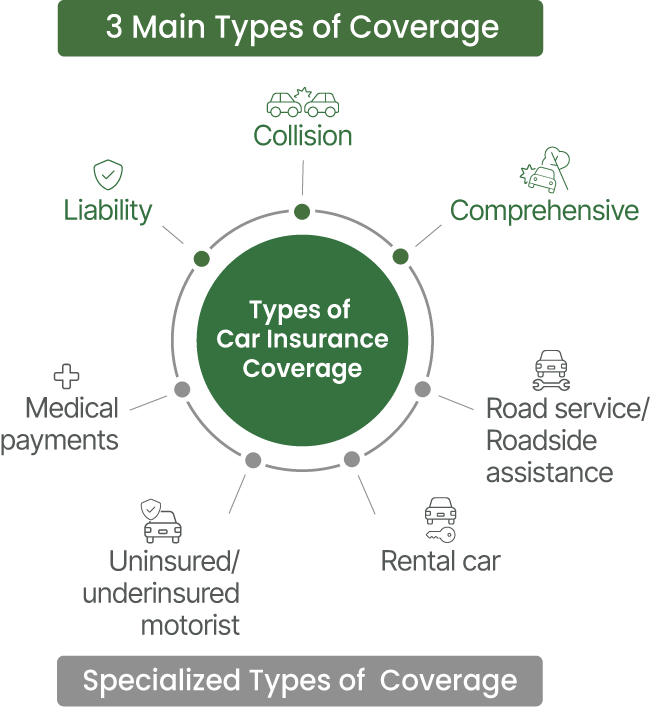
When shopping for auto insurance, you'll have a lot of decisions to make, including choosing between full coverage (i.e., liability coverage, collision coverage, and comprehensive coverage) and minimum coverage, which only includes liability coverage at your state's minimum requirements. Your independent insurance agent can help you get a clear, personalized picture of the coverage you need for your car, based on your unique situation. However, your auto insurance policy will generally include three main types of coverage. See our full guide to car insurance coverage types for a complete breakdown of every option available.
The most common car insurance coverage types
- Liability: This covers you against losses if you’re at fault in a car accident. Liability is typically broken down into three key limits: bodily injury per person, bodily injury per accident, and property damage. The liability limits you choose, such as $100,000/$300,000/$50,000, respectively, are the maximum amounts the insurer will pay.
- Collision: This pays for damage to your car from a collision with another object, regardless of fault. Typically, if the accident is ruled the other person’s fault, their insurance would pay for your damage. But if you cause the accident, or if you live in a no-fault car insurance state, your collision coverage will pay for the damage to your own vehicle. Collision insurance costs an average of $290 per year.
- Comprehensive: Also known as "other than collision," this pays for damage to your car due to a non-collision event, such as a flood or theft. It covers many different types of damage, including that from fire, hail, falling objects, and collisions with large animals. Comprehensive coverage costs an average of $134 per year.
Additional car insurance coverage options
- Uninsured/underinsured motorist: Required in some states, this is meant to cover your own injuries and property damage if the at-fault party either has no insurance or not enough to fully cover your expenses.
- Medical payments: This is paid out to you and anyone in your vehicle if you suffer injuries in an accident. This is considered no-fault insurance, so it doesn’t matter who caused the accident or how. If you got hurt in your car, you’re eligible.
- Gap coverage: Because cars depreciate so quickly (especially immediately after purchase) and insurers only pay current market value, gap coverage can help pay the difference between the purchase price and your remaining loan balance.
- Rental car coverage: If your car requires repairs after an accident, this coverage will pay for you to temporarily rent a vehicle, up to a certain limit.
- Roadside assistance: If you become stranded on the road, this coverage can pay for professional towing, battery jump starts, and other roadside services to help you.
An independent insurance agent can help you build a complete car insurance policy with every type of coverage you need.
Situations Car Insurance Typically Does Not Cover
It’s a good idea to familiarize yourself with your car insurance policy as much as possible. After all, the more you know about your coverage, the easier it is to avoid the hassle of filing sure-to-be-denied claims.
Car insurance usually does not cover the following:
- Certain natural disasters (e.g., floods, earthquakes, and mudslides)
- Wear and tear damage (i.e., that resulting from poor upkeep)
- Commercial use of vehicles (e.g., transporting goods for a business, or driving for a service such as Uber or Lyft, which requires rideshare insurance coverage)
- Certain vehicle modifications and add-ons
Your independent insurance agent can help review your specific car insurance policy's list of coverage exclusions with you, so you can be certain of what's not covered.
Who Is Included on My Car Insurance Policy?
When requesting car insurance, you’ll want to include any titled vehicle that could be driven. Car insurance primarily follows the car and not the driver in most locations. So if you're pulled over, the police officer is generally looking to see if the vehicle is insured, not if the driver is on the policy.
In many cases, you can let anybody drive your vehicle, and they will be covered under your policy. But insurance companies still want you to list anyone who has regular access to your vehicle as a driver.
WARNING: If you knowingly omit a driver, such as your teenager who just got their license, you could risk having your claim denied by the insurance company.
How Much Does Car Insurance Cost per Month in 2026?
The average cost of car insurance in the U.S. is $2,575 per year, or approximately $216 per month for full coverage. The average car insurance cost in 2026 for minimum coverage is $1,202 annually or $100 monthly. Some states, such as Michigan and Louisiana, have higher car insurance rates, whereas Wyoming and Vermont have much lower rates.
Your local independent agent can best help you understand rates in your area. There are several factors that go into car insurance premium rate calculations. You can also use our car insurance calculator to get a better idea of the estimated cost of your car insurance.
The biggest factors that affect your car insurance rate
Many different factors can affect car insurance costs, including the following:
- Age: Drivers under 25 typically pay much higher rates, mainly because that age group is statistically involved in the most accidents.
- Location: City drivers often pay more than rural drivers due to the increased likelihood of filing a claim, such as due to traffic jams, thefts, and other threats in densely populated areas.
- Gender: Female drivers sometimes have lower rates than male drivers, likely due to their better driving records.
- Driving history: If you’re a safe driver with no history of accidents or violations, you’ll have fairly low rates for your vehicle type and location.
- Type of vehicle: The more expensive the vehicle, the more it will cost to insure because the insurance company will have to pay more money to replace it in the event of a total loss.
- Current insurance: If you don’t have prior insurance or have a long lapse in coverage, your options will be more limited, and you’ll likely pay higher rates.
- Credit score: Most states use your credit score as a rating factor, with better credit scores leading to lower rates. Drivers with poor credit scores pay an average of $4,720 per year for car insurance, compared with $ 2,524 for drivers with good credit.
- Annual mileage: The less often you drive your car, the less likely you are to file a claim. Drivers who maintain low annual mileage are often rewarded with lower premiums.
- Telematics: Some car insurance companies offer telematics programs that track your driving behaviors. You may be rewarded with discounts for safe driving habits, so be sure to ask your carrier about available telematics-based car insurance savings.
- Repair costs: The more expensive it is to repair or replace your vehicle's parts, the more expensive your car insurance is likely to be.
Your independent insurance agent can further explain these factors and others that go into determining car insurance premium rates.
How your driving record impacts your rate
Speeding tickets, traffic accidents, and other violations can greatly impact your car insurance costs. Average rates for car insurance after a DUI increase by as much as 96%. Just one speeding ticket could lead to an increase of between 20%-68%. Further, one at-fault accident on your record could lead to an average premium increase of between $225-$322 per month.
Shopping for new car insurance after a traffic violation or accident is typically recommended. An independent insurance agent can help you compare car insurance quotes to find the cheapest coverage after an accident, DUI, speeding ticket, etc.
The Best Car Insurance Companies in 2026
Car insurance companies may offer the best rates for one driver, but not another. The table below breaks down the best carriers by category for 2026. You can also check out our full list of the best car insurance companies this year to get a better idea of where to shop for quality coverage at a great rate.
| Top Car Insurance Companies | Average Full Coverage Premium | Best For |
|---|---|---|
| Travelers | $139/month | Millennial, Gen X, and senior drivers; Drivers with speeding tickets; Drivers with at-fault accidents; Drivers with poor credit |
| USAA | $130/month | Military members, veterans, and their families |
| Progressive | $223/month | Young drivers; Drivers with a DUI |
The Best Ways to Save on Car Insurance in 2026
Car insurance discounts are pretty common, with a number of ways to help you save through certain key behaviors. If you've been wondering how to save on car insurance, it's helpful to review a common car insurance discounts list to see which you might be eligible for. Each company offers slightly different discount options, but a few of the more common options include the following:
- Multi-policy or bundling: You can typically knock off 10% to 25% when you bundle your car insurance with a homeowners insurance or renters insurance policy through the same carrier.
- Multi-vehicle: If you insure multiple vehicles on one policy, you’re likely to receive this discount, making the overall cost slightly less expensive than if they were insured separately.
- Vehicle safety features: Most new vehicles include advanced safety features, such as passive or active restraints and blind-spot monitoring. The better the safety features, the lower the risk and car insurance rates.
- Safe driver: A safe driving record over the last three to five years is a big indicator that you’re probably very cautious, and insurers often reward that with substantial savings.
- Good student discount: Having younger drivers on your policy can have a dramatic impact on your rates. To help offset this, your child could receive a good student discount if they earned at least a B average last semester.
- Defensive driving course: If you don't qualify for a safe driving discount, you can complete an approved defensive driving course to receive a discount from many different insurers.
- Telematics: Offered by some insurers, this tracks your driving over time and gives you a discount based on your driving habits and performance. Be sure to ask your independent insurance agent about Progressive Snapshot, Allstate Drivewise, and Nationwide SmartRide.
- Usage-based/pay-per-mile: If you drive your car less than a certain number of miles per year, you may qualify for savings from your carrier.
There are usually many more discounts available, such as paying your policy in full, enrolling in automatic payments, quoting in advance, and going paperless. Be sure to talk with an independent insurance agent to find out which discounts you qualify for.
How to Compare Car Insurance Quotes (and Actually Save)
When shopping for car insurance, it’s a good idea to work with an independent insurance agent to compare quotes. There are many independent insurance agent car insurance benefits to consider. First, these agents can compare quotes from more than 10 carriers in one step. Additionally, most agencies offer free quotes online. Here’s what you’ll want to look for when you compare quotes:
- Coverage: Be sure to select the same amount of coverage for each quote in the following categories:
- Bodily injury liability and property damage liability coverage
- Medical payments coverage
- Uninsured motorist coverage
- Collision coverage
- Comprehensive coverage
- Policy limits: This is the minimum and maximum amount the insurer will pay for a claim. Coverage limits of 100/300/100 are typically recommended. This means your policy will cover up to $100,000 per person and $300,000 per accident for bodily injury liability and up to $100,000 per accident for property damage liability.
- Deductible amount: Think about how much it will cost to repair your vehicle and how much you’d be able to pay from your savings. In general, increasing your deductible lowers your premiums. However, the greater your deductible amount, the more you'll have to pay out of your own pocket before being reimbursed for a claim.
- Additional coverage: You might also ask about windshield replacement and rental car reimbursement, among others.
- Discounts: Ask your independent insurance agent about any car insurance discounts you may qualify for to increase your savings as much as possible.
An independent insurance agent has access to dozens of top-rated car insurance companies in your area. They can shop and compare quotes simultaneously to help you find the best rate.
What Information Do You Need to Get a Car Insurance Quote?
When requesting a free car insurance quote, you’ll want to have the following information handy:
- Your name and phone number
- Driver’s license numbers for all drivers
- The make, model, and year of the car or vehicles to be insured
- Vehicle Identification Number (VIN) for each vehicle
- Safety features, such as anti-lock brakes (ABS) or passive restraint systems
- Anti-theft devices, such as GPS trackers
- An estimate of how many miles the vehicle will be driven annually
- Your ZIP Code and where you live
Your independent insurance agent can also help you gather any additional information needed to get an accurate car insurance quote.
FAQs About Car Insurance
Is car insurance required in every state?
Car insurance isn’t always required by law, but nearly every state requires some minimum protection before you hit the road, which is typically liability insurance. That coverage is designed to protect anyone or anything from damage or injuries inflicted in an accident. Some states, however, even require additional coverage, including collision and comprehensive protection.
New Jersey just updated its minimum coverage requirements in 2026, so be sure to review these changes with your independent insurance agent and update your policy if necessary.
No matter which state you live in, it's important to have some sort of coverage to help cover damage and injuries and get you back to normal as quickly as possible after an accident. Coverage amounts of 100/300/100 are typically recommended for most drivers.
Why do I need car insurance?
Simply put, because every time you get into a vehicle, you take a risk. You may be an incredible driver, but you're not the only one on the road. Auto insurance helps provide a safety net when drivers make mistakes.
If you're at fault, you're typically liable for damage to the other person’s vehicle as well as the medical and legal costs of injured victims, plus the repairs to your own vehicle.
If you're not at fault, and the other driver doesn't have adequate insurance, you'll have to pay for all the damage to your own car, plus any medical bills if you're badly injured.
How much does car insurance cost?
It's hard to offer an exact figure without knowing all the details of your vehicle and driving history, but the average cost of car insurance in 2026 is $2,575 annually for full coverage and $1,202 for minimum coverage. Keep in mind, if you drive a particularly valuable vehicle or have an accident or two under your belt, you can expect that number to increase sharply. However, if you have a clean driving record, good grades, or are part of an affinity group, you could get a nice discount to help lower your rates.
Why should I work with an independent insurance agent?
With access to multiple insurance companies, independent insurance agents are unlike any other type of agent out there. They’ll help find you the best coverage options and most competitive prices, all for free.
How do I choose the right car insurance deductible?
As you can imagine, the higher the deductible, the lower your premiums. But it’s important to think of your current and future budget. You want to make sure your premiums fit comfortably into your current planned budget. Additionally, think of how much you'd be able to pay on your own if an accident happened. Your agent can help you find the best option for your situation.
Does car insurance cover theft?
If your car is stolen, there are a few steps you need to take to be compensated for your loss and get back on the road. First, you'll need to file a police report and wait while an attempt is made to recover the stolen vehicle. If your car isn't recovered, and you have comprehensive coverage, you can file a claim with your insurance company. After a bit of paperwork, your insurance will compensate you for the value of the vehicle up to the limit of your comprehensive coverage.
Does car insurance cover rental cars?
When you rent a car, your rental agent will probably try to sell you insurance at an extra cost. Do you need it? In most instances, if you have car insurance that includes liability coverage it will apply to your rental car. However, before you rent a car, it’s a good idea to review your insurance policy to see exactly what coverage you have.
The credit card you use to rent a car may also provide a certain amount of rental car insurance. This is usually secondary insurance. If you get into an accident or your rental car is stolen, the company will bill your car insurance first, and your deductible will apply to the claim. Again. It’s a good idea to call the credit card company and find out what coverage they offer.
Read our full article: does car insurance cover rental cars?
Who needs high-risk insurance?
High-risk insurance is determined by your driving record, with recent driver history the most important factor. A driver is considered high-risk if they have multiple violations, such as speeding tickets or if they’ve been convicted of a DUI/DWI. Other factors include poor driving records, younger or inexperienced drivers, lapses in coverage, at-fault accidents, and vehicles that are considered at higher risk of getting into accidents. High-risk drivers pay about 54% more on average than safe drivers.
Can I get same-day car insurance?
Yes, many insurers let you start same-day car insurance, but you’ll need to be ready with your details and understand that there are a few exceptions. Most major carriers can quote and start coverage immediately online, over the phone, or through an independent insurance agent, and you’ll typically get proof of insurance right away.
To do this quickly, you’ll need basics like your address, driver’s license, vehicle details, driving history, and sometimes your Social Security number. Delays can happen if you lack a permanent address, have a high‑risk record, drive a rare/classic car, or have poor credit. It’s usually safe to buy same-day coverage, but if you’re not in a rush, you may actually save more by taking extra time to compare options, look for discounts (e.g., bundling), and avoid coverage gaps.
What is the difference between full coverage and minimum coverage?
Full coverage refers to an auto policy that includes liability coverage, collision coverage, and comprehensive coverage, but this isn't an official industry standard term. Minimum coverage refers to a policy that includes only your state's mandated liability coverage. Lenders typically require full coverage for financed vehicles.
Does my credit score affect my car insurance rate?
Yes. Poor credit scores (below 580) can increase your car insurance rates by as much as 76%-100%. However, certain states, including California, Hawaii, and Massachusetts prohibit credit-based insurance scoring.
An Independent Insurance Agent Can Help You Find the Best Car Insurance
When it's time to find the best car insurance, no one's better equipped to help than a local independent insurance agent. Your agent knows which local carriers deliver the best overall blend of auto insurance coverage and cost.
An independent insurance agent can shop and compare several quotes from dozens of insurance companies simultaneously, including Progressive, Nationwide, USAA, and Travelers, to find the cheapest coverage near you. And down the road, your agent will still be there to help you file car insurance claims if the time comes.